How to plan a month of social media content in 60 seconds with AI
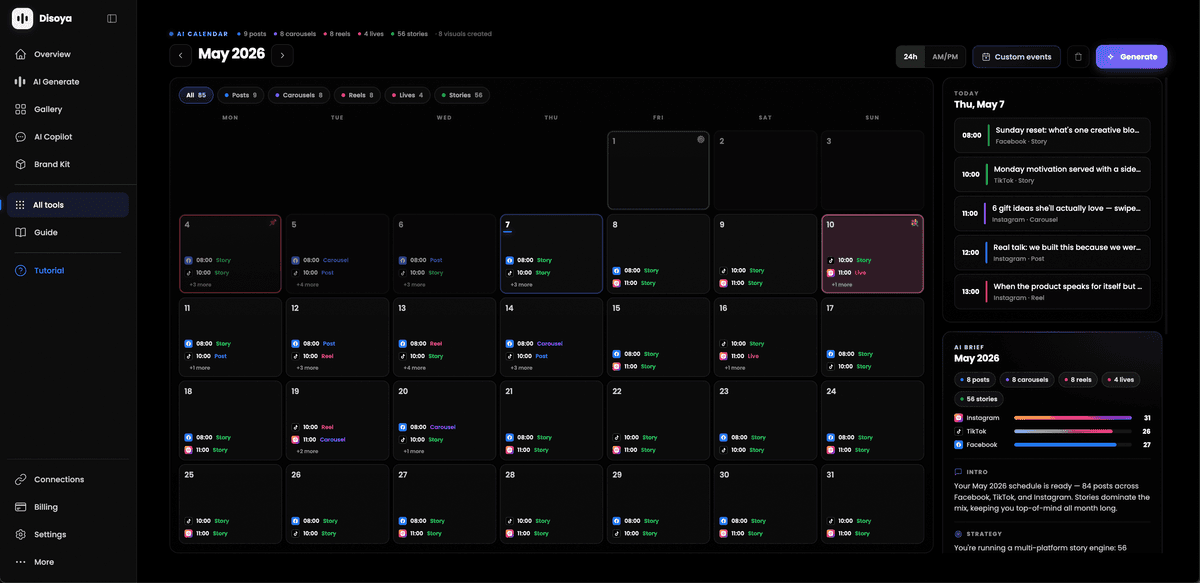
Posting consistently is the single biggest predictor of social media growth. Brands that post daily on Instagram and TikTok grow 3-5× faster than brands posting twice a week — that's the well-documented compounding effect of the algorithm. Yet daily posting requires planning, and planning eats 4-6 hours a month.
The bottleneck isn't creativity. It's logistics: figuring out what to post on which day, at what time, on which platform, with what hook, with what CTA. AI calendars solve this — not by replacing your judgment, but by handling the structural work in seconds.
What an AI content calendar generates
A good AI calendar takes three inputs (your industry, your active platforms, your posting frequency) and outputs a full 30-day schedule with: post type per day (photo, video, carousel, story), specific hook ideas, suggested captions and hashtags, recommended posting time per platform, and a brief explaining the strategic intent of each post.
You don't get a generic "post Monday at 9am" — you get "Monday 8:47am EST: Reel showing your product in use, hook is curiosity-based, CTA drives to your DM bot". That level of specificity is what turns daily posting from a chore into a system.
Best-time-to-post per platform
Instagram Reels peak windows are different from TikTok windows. LinkedIn doesn't care about weekends. Pinterest performs best in 6 PM EST evening windows. AI calendars built for 2026 include these timing rules per platform — so a single content plan stays optimized regardless of where each piece goes.
Disoya's calendar uses platform-specific peak windows tuned to your selected industry — fragrance brands peak at different times than fitness brands, and the model accounts for this.
The brief is the killer feature
Anyone can generate a list of 30 post ideas. The hard part is knowing WHY each one belongs there. A good AI calendar attaches a strategic brief to every post: what stage of the funnel it serves, what audience reaction to optimize for, what to avoid.
This means a freelancer or social media manager can take the plan and execute it without 10 back-and-forths with the founder. The intent is documented inline, on every cell.
Drag-and-drop is non-negotiable
No AI plan survives contact with reality. A product launches Tuesday, a competitor drops a campaign Wednesday, an influencer DMs you Thursday. The calendar that helps you ship is the one you can rearrange instantly — drag a post to a new day, swap a Reel for a Story, push everything one day forward.
Static calendars (the kind people print) get abandoned in week 2. Drag-and-drop calendars survive because they bend with reality.
Auto-publish closes the loop
The full workflow now: AI generates your visual → AI writes your caption → AI plans your calendar → AI publishes at the optimal time. The whole pipeline runs without you touching it. Your job becomes setting direction once a month and approving outputs — not producing daily.
This is the inversion most brands haven't noticed yet. The "social media manager" job in 2026 isn't about producing content. It's about defining the brand inputs (Brand Kit), reviewing the AI outputs, and steering the strategy. Production became infrastructure.
Try it yourself
Set up your Brand Kit (10 minutes), click "Generate calendar", pick your platforms and frequency. In 60 seconds you have a full 30-day plan with hooks, captions, timing and strategy briefs. Drag the cards to fit your launches. Connect your Instagram and Facebook accounts and let auto-publish handle the rest.
The brands posting daily without burning out aren't superhuman. They're using AI to compress the planning work from 6 hours into 60 seconds — and using the saved time on strategy, community and product. That's the unfair advantage compounding right now.